Page 8 of 9 FirstFirst ... 456789 LastLast
Results 71 to 80 of 89

Thread: Improving Red (Maybe ALL) Beams

  1. #71
    Join Date
    Jul 2014
    Location
    Manchester, NH
    Posts
    28

    Default

    Part of the measurement uncertainty is that all the bright stuff above the main beam, merges into the two rectangles that are imaged and measured near field, right at the aperture. There are no external optics in use. As I am sure you know, the near field appears as two neat little rectangles side by side.

  2. #72
    Join Date
    Feb 2011
    Location
    New Hampshire
    Posts
    3,513

    Default

    Good image, this says a lot. I'll bet there are two or four diodes in this module. If four, it would seem that two of them are pretty well co-aligned in the lower, brighter stripe and the other two are the other somewhat dimmer stripes: one is just above the main line and the fourth at an angle and above and to the left of the other three. The fourth one is a problem especially due to the rotation. Any beam correction will be limited because in order to compress the other 3 the fourth will remain as thick as the vertical distance from it's highest left end to its lowest right end.

    What I do not understand is that these diodes do not look corrected or in other words beam expanded in the module. This is how they look in the far field when they are only collimated and then combined either with a PBS and or a knife edge. However, if they are not beam expanded in the module then they should not be so large in the near field. Also, 20mm @ 30 feet or 9000mm is about 2.2mrad which is also consistent with an unexpanded beam. Divergence can be misleading here because an unexpanded beam from a diode is so close to zero mm wide that the full 20mm is a typical expansion of an uncorrected diode and you could correctly state that the divergence is about 2.2mrad. Because their beam is starting so fat the calculation changes to 20 - 6.2= 13.8mm over 9000mm and about 1.5mrad. But still, there is no reason the beams should be so fat in the near field in the first place. Using a PBS to overlay the two pairs of diodes should produce a single vertical line about 6mm high then beam expanding them to 6mm wide should bring the far field down to about 5mm wide not 20mm.

    Tribble,
    I believe that we are almost always focusing at the far field and the farther the far field is from the projector, the better. For the most concentrated beams within a given distance it is beat to have the beam waist at the far field. So if the projector will be used to project out to say 20M than focusing the beams to say 30M will give a conservative alignment.

  3. #73
    Join Date
    Jul 2014
    Location
    Manchester, NH
    Posts
    28

    Default

    Planters,

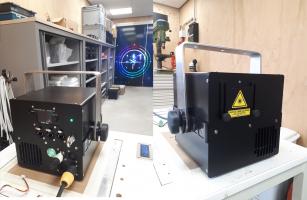
    I would say that it is four diodes as I can see the individual beams exiting at the aperture.

    As a former Laserwave distributor, what do you think? Should I send it back to China, refund, rework or "upgrade"?

  4. #74
    Join Date
    Aug 2013
    Location
    Vilnius, Lithuania
    Posts
    67

    Default

    Great pics, makes the case much clearer.

    planters will correct me if i'm wrong, but the only way I see this possible is there's no correction optics, but collimators are relatively long FL. Getting divergence of the FA to 2.2mrad (let alone 1.5mrad) is impossible with short FL collimators (I'm not sure with what FL it becomes impossible, but with anything lower than 5-6mm it should be). Furthermore, longer FL lens enables stronger focus in the far field if LD is out of the focus point. that's how they're keeping 2.5mm@30ft of the SA. And, of course, long FL colli lens leads to bigger beam dimensions @ aperture.
    resunltd, if you took apart that box, you'd probably see 2 pairs of knife edged diodes without correction optics, combined with PBS. if you're about to build red yourself, you'd like to use the shorter FL lens for collimation, add cylindricals for correction, and get knife edge and PBSing done more precisely. considering the probability of finding lots of epoxy on every component which effectively makes them not reusable, I wouldn't advice you doing it. Best thing to do would be to get your money back (if that's possible) and build module by yourself or buy it from edison (or in the middle: buy the kit from edison and finish building it by yourself). I'm not sure what is other laserwave stuff and what will you get if you 'upgrade' it, maybe planters know better.

  5. #75
    Join Date
    Dec 2008
    Location
    veenwouden
    Posts
    2,579

    Default

    The module is a Longer FL setup for sure. From what i have seen on the picture its a dual setup but i,m not 100% sure. It can be also a be 2 dual PBS steps and then knivedged. That is when its a 2 watt red here. When its a 1 watt red then for sure its a dual setup with Longer FL lens. Spatial filtering is the way to go to "clean" the beam for multimodes but for beamshows its not nessesary. Single mode is the easiest way to get a clean beam and a very low divergence. With that low divergence you can go with allot less power to have the same brightness as the one you have now. Its all about divergence but unfortunally the Eventmanagers think only Power. But once they hired you and see a less power but extremely bright projector they will be convinced. Especially when showing some graphics.


    Interested in 6-12W RGB projectors with low divergence? Contact me by PM!

  6. #76
    Join Date
    May 2014
    Location
    Barcelona, Spain
    Posts
    439

    Default

    Quote Originally Posted by planters View Post
    The far field looks almost square to me as in about X=9mm by Y=7.5mm. The "wings" in the far field are just what spatial filtering is designed to eliminate. Your divergence is actually quite low. The problem is in the near field. Those numbers are not acceptable. You might also try measuring the very bright near field by taking a dielectric coated mirror and reflecting almost all of the beam straight down to the base and then projecting the 1% or so that leaks through on to a surface that you can measure against. If the numbers still hold up and you have some good images that verify that then send that to bridge. You should not be forced to use a scanner designed for a Laserscope for a 2W red
    module.


    You have the 3mm aperture 506 scanner mirrors, but even the 5mm aperture mirrors will not handle the beam you seem to be showing.
    Hi Planters,
    Please just 2 questions: I've recently ordered 506 from Justin, but he said me actual 506s come with 3mm or 4mm mirror aperture configurations, not 5mm. So I ordered 4mm aperture. I wished to buy 5mm aperture, because my beams are 4-5mm... do you really own 506 at 5mm aperture? how is that possible?
    And my other question please, for red collimator, what about G2 instead Optima 4mm? I think G2 is also about F4mm...so, maybe same results?
    Many thanks!
    Jordi

  7. #77
    Join Date
    Feb 2011
    Location
    New Hampshire
    Posts
    3,513

    Default

    I think Justin is just being Justin...conservative. I have the larger of the only two choices they offer and it is fine for the 4.5mm beams I generate. The 506's can come with the largest mirror set I know of short of a big beam steering unit.

    I do not think it matters what the FL of the collimator is as long as the lens is an aspheric and coated for the wavelength. The beam expansion lenses will bring you to the same near field to divergence ratio. I have never used a G2, so it might be wise to confirm the wavelength compatibility. The rest is a sure thing.

  8. #78
    Join Date
    May 2014
    Location
    Barcelona, Spain
    Posts
    439

    Default

    Quote Originally Posted by planters View Post
    I think Justin is just being Justin...conservative. I have the larger of the only two choices they offer and it is fine for the 4.5mm beams I generate. The 506's can come with the largest mirror set I know of short of a big beam steering unit.

    I do not think it matters what the FL of the collimator is as long as the lens is an aspheric and coated for the wavelength. The beam expansion lenses will bring you to the same near field to divergence ratio. I have never used a G2, so it might be wise to confirm the wavelength compatibility. The rest is a sure thing.
    Many thanks Eric.
    Just an update:
    I emailed Justin yesterday, they are offering now 4.5/5mm aperture and 3/4mm as well. Cause my 506s are on production its not too late for me, so I'm going for the 5mm aperture route because my red is about 4-5mm for low divergence.
    Also it seems their amps are just about ready but no dates yet. grrrr patience,patience,patience....

  9. #79
    Join Date
    Aug 2013
    Location
    Vilnius, Lithuania
    Posts
    67

    Default

    Quote Originally Posted by planters View Post
    I do not think it matters what the FL of the collimator is as long as the lens is an aspheric and coated for the wavelength. The beam expansion lenses will bring you to the same near field to divergence ratio. I have never used a G2, so it might be wise to confirm the wavelength compatibility. The rest is a sure thing.
    The longer FL collimator gives wider beam at the apperture. However it determines only SA as FA is usually expanded by the correction. In the same way bigger FL collimator gives lower divergence. So in theory one should strive to get as big FL collimator as possible within the required aperture beam width. Generally that's what all (or most) chinese suppliers do: they put long FL lens as a collimator, so long that even FA divergence becomes... 'acceptable', and then don't even bothers correcting it. Nice/cheap approach, however, in the cost of wide beam at aperture (and FA/SA divergence difference)

    jors, I haven't tried G2 lenses yet (I will get a couple in few days, maybe even today), but as far as I've heard they are coated for blue only and green is at the edge with the acceptable losses. I cannot confirm this yet by myself. But if you need this info, I'll probably be able to test them with 462, 520, 638 pretty soon

  10. #80
    Join Date
    May 2014
    Location
    Barcelona, Spain
    Posts
    439

    Default

    Thanks Sandstorm, I think Jordan (DTR) G2 lenses are broadband coated, so also suitable for 638nm. I have some units here.
    Anyway, I've ordered some DAVE mounts and F2 collimators like I did on my 1st projector but I'll go for 6x cylindrical instead 4x this time, so I expect 4-5mm near field @1/1.20 mrad.
    However, I'd wish to bypass the tedious 'centering' F2 lens and find a better option more-easy setup. Say for instance...G2 plus cylindricals. This is why asked Planters. I think G2 is between F4/F5...

Posting Permissions

  • You may not post new threads
  • You may not post replies
  • You may not post attachments
  • You may not edit your posts
  •