
I don't want to be nitpicking here but ...
Krutz is right, supposing it is a linear current regulator. Seeing that this is such a compact device, the current source will most likely be switchmode.
Meaning nothing will overheat if you short a diode.

 Senior Member

I don't want to be nitpicking here but ...
Krutz is right, supposing it is a linear current regulator. Seeing that this is such a compact device, the current source will most likely be switchmode.
Meaning nothing will overheat if you short a diode.
Senior Member
I can confirm they are in banks of 6 diodes, in 3x2 arrangements. They are being run constant current in the projector, however the electronics are quite picky about making sure the voltage is in the correct range as well. I haven't had a chance to test it directly, but it will shut down and flash the overheat light of you try to short out a diode. I am working on getting around this however!
 Senior Member
My projector operates normally with a blown laser (now an LED). Perhaps I could substitute good laser diodes with blown ones? There will likely be some available soon as more people experiment.Originally Posted by krazer

 el gringo loco

...this may 'shed some light' (photo by others...)
cheers...
j
....and armed only with his trusty 21 Zorgawatt KTiOPO4...


You are correct. I had erroneously assumed that this used a simple linear voltage regulator, rather than a constant current regulator. My bad.
Adam
 Junior Member
I know this is an older thread, but just thought I'd chime in. Any news on replacing a row of laser diodes in the projector?
I think you 'll have to use regular 1N400x diodes rather than LEDs to replace them. The pulsed current through these laser diodes (measured by krazer) is nearly 1.5 AMPs. LEDs' typical If (forward current) is 20-30 mA. Maybe 50-100 mA if pulsed. Put 1.5 amps through an LED and you get a great flashbulb.
The Vf (forward voltage drop) of the 445nM laser diodes at that current is close to 5 volts. So, you would need about 7 diodes in series (at .7V drop across each silicon 1N400x) to get 4.9V to be the same as the Vf of the laser diode.
You might be able to use one of the Luxeon or similar very high brightness LEDs. They have a Imax (max forward current) of nearly 1A. The Vf at this current is about 3.7-4.2 Volts.
Standard high brightness (blue, white, green) LEDs have a specified Imax of only 30mA, and the Vf at this current is 3.2-3.9Volts.
--
Greg
Those blue photons are the prettiest.
Senior Member
There really is no reason to use LED's or dead lasers, a simple diode will work fine. A 1A rated diode would probably work due to the pulsing, but it will get toasty so I recommend using a 3A diode. It should also be possible to get away with just a simple resistor, although due to the different IV characteristics the projector may freak out.
Junior Member
krazer, in your post of 6-9, you said:
the electronics are quite picky about making sure the voltage is in the correct range as well.
So, I assumed the electronics would complain about seeing 4.2 volts difference (between the 4.9V laser diode, and a .7V 1N400x silicon diode replacement.
In any case, I think a regular (high intensity) LED running at 1.5amps pulsed wouldn't last very long in there.
--
Greg
Those blue photons are the prettiest.
 Senior Member
why not a 5 amperes rated zener diode? it would drop the right voltage and cope with the power
 Senior Member
I believe that this is the best solution, heroic also suggested this in IRC chat (y'all miss out on the good stuff).
-Adam
Support your local Janitor- not solicited
.
Laser (the acronym derived from Light Amplification by Stimulated Emissions of Radiation) is a spectacular manifestation of this process. It is a source which emits a kind of light of unrivaled purity and intensity not found in any of the previously known sources of radiation. - Lasers & Non-Linear Optics, B.B. Laud.

 Posting Permissions


 Reply With Quote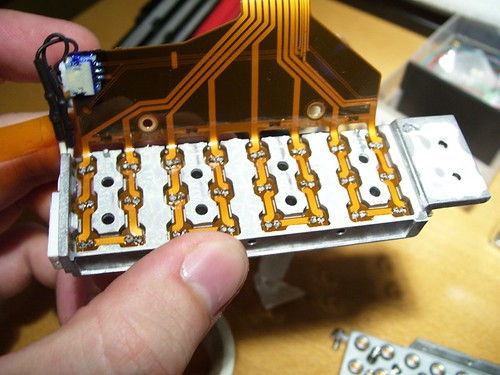
 buffo
buffo